
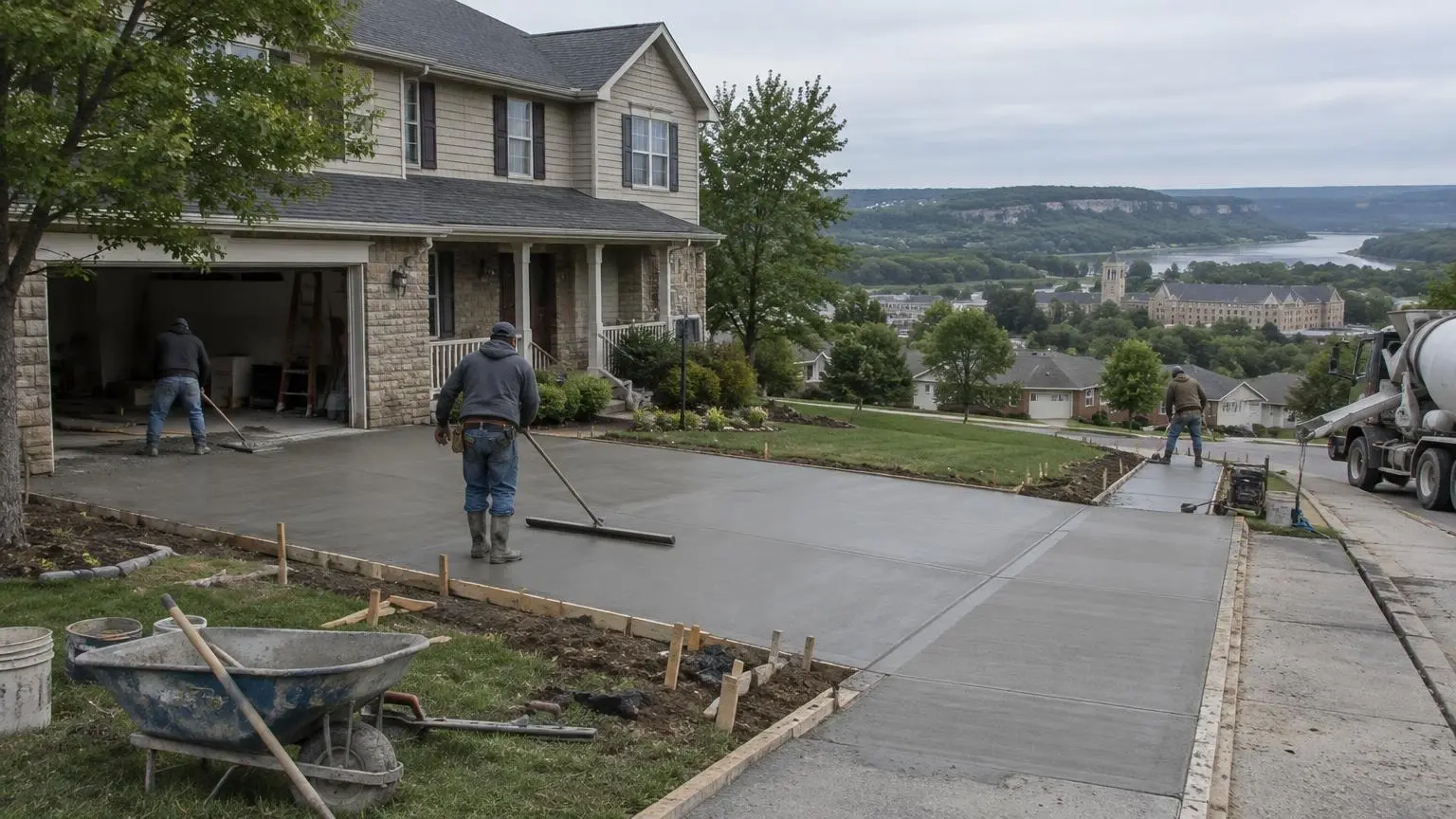
Partly moved to higher ground when Milford Lake was built
Concrete Contractors in Wakefield, KS
Driveways, patios and slabs for a Clay County town on the shore of Milford Lake.
- We measure on site before naming a price, and the quote arrives in writing, line by line
- Every outdoor pour: compacted crushed rock underneath, air-entrained concrete, joints laid out ahead of time
- Permit and right-of-way questions checked with the city or county before a date is booked
Wakefield Concrete, From the Ground Up
Wakefield is a Clay County town on Milford Lake, and the concrete contractors who work here need to understand how the lake reshaped it. The town was founded in 1869 and incorporated in 1887. Its name honors Rev. Richard Wake, one of the men who started the town, and Wakefield, England, the hometown of another. A railroad came through in 1873. In the 1960s, when Milford Dam was built on the Republican River, parts of Wakefield were moved to higher ground.
Winter on the lake shore
Open water and open country let wind move freely across Wakefield, and winter brings repeated freezing and thawing. Exterior concrete takes that in two ways: water that soaks into the surface freezes and expands, and deicing salt speeds up the damage. The fix starts with the mix. We use air-entrained concrete for every outdoor slab, so tiny bubbles inside give freezing water room to expand. We finish the surface without overworking it, since overworked concrete brings water to the top and weakens it. After the slab cures, a penetrating sealer adds another layer of protection. For homeowners, the simplest habit is to shovel early, use sand for traction and keep rock salt off concrete in its first winter.
Why the 1960s still matter under your slab
Milford Lake started filling on January 16, 1967, and reached its planned pool level that July. Two towns, Alida and Broughton, disappeared, and parts of Wakefield and Milford were relocated. When ground is reshaped on that scale, some lots end up on cut slopes and others on fill.
Fill can be perfectly good under a slab if it was placed in thin layers and compacted. If it was not, it keeps settling, slowly, for years. Before we pour anything in Wakefield we probe the ground, look for soft spots and check how water moves across the lot. Where the base is weak, we dig it out and replace it with compacted crushed rock. That step adds time, but it is the difference between a slab that stays flat and one that tips within a few winters.
Questions we ask on a Wakefield site visit
- Has the slab or the ground around it settled before?
- Does water pond anywhere after a heavy rain?
- Will the slab carry a vehicle, a boat trailer or just foot traffic?
- Are there trees whose roots run under the area?
- Is there a downspout that empties onto the spot?
The answers decide how thick the slab should be, whether it needs rebar, and how we slope and joint it.
A small town with long-lived homes
The census counted 980 residents in 2010 and 858 in 2020, with 413 housing units in 2010. Wakefield sits at about 1,260 feet. With a stable housing stock, most concrete work here is replacing worn slabs rather than building new. That usually means front steps that have pulled away from a porch, driveways broken by years of freeze-thaw, and walks that heaved in one spot and sank in another.
New concrete in Wakefield gets the same standards we use everywhere around Manhattan: air-entrained mixes for freeze-thaw resistance, correct thickness for the load, control joints at the right spacing and careful curing. For lake households with boats and campers, we often pour a heavier pad beside the driveway sized to the trailer.
A different county
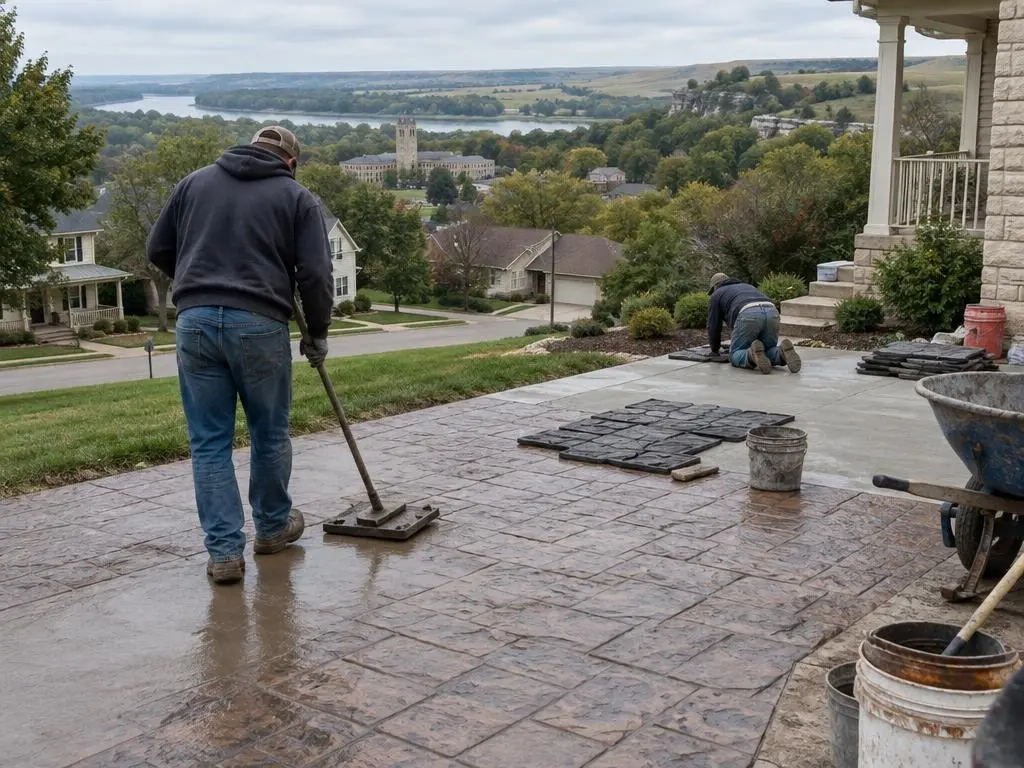
Wakefield is in Clay County, outside the Riley, Pottawatomie and Geary county area around Manhattan. Rules for a garage slab or a new driveway approach are set locally, so we check with the City of Wakefield or Clay County, depending on the address, instead of assuming they match Manhattan's. The work itself is the same list: driveways, patios, stamped concrete, walks and steps, garage and shed slabs, and repair. Call (785) 509-7585 to schedule a visit to your Wakefield property.
Wakefield Background
- Lake relocation. Parts of Wakefield were moved to higher ground when Milford Lake was built in the 1960s.
- Founded. Wakefield was founded in 1869, incorporated in 1887 and reached by the railroad in 1873.
- Population. The town had 980 residents in 2010 and 858 in 2020, in Clay County at about 1,260 feet.
Our Services in Wakefield, KS
Wakefield Questions
Why do you probe the soil before pouring in Wakefield?
Some lots were regraded when parts of town moved for Milford Lake. Probing finds soft fill so we can replace it with compacted rock before pouring.
Can you pour a pad for my boat trailer?
Yes. We make it thicker than a patio, add rebar and set it on compacted crushed rock so it carries the trailer's weight.
My front steps pulled away from the porch. What causes that?
Usually the steps have no real footing and the soil under them settled. We replace them with steps on a proper footing.
Concrete Contractors Near Wakefield
- Concrete Contractors in Manhattan, KS
- Concrete Contractors in Junction City, KS
- Concrete Contractors in Fort Riley, KS
- Concrete Contractors in Wamego, KS
- Concrete Contractors in Ogden, KS
- Concrete Contractors in Grandview Plaza, KS
- Concrete Contractors in Milford, KS
- Concrete Contractors in St. George, KS
- Concrete Contractors in Riley, KS
- Concrete Contractors in Leonardville, KS
- Concrete Contractors in Westmoreland, KS
- Concrete Contractors in St. Marys, KS
- Concrete Contractors in Alma, KS
- Concrete Contractors in Randolph, KS
- Concrete Contractors in Olsburg, KS
- Concrete Contractors in Chapman, KS
- Concrete Contractors in Louisville, KS
- Concrete Contractors in Keats, KS
- Concrete Contractors in Belvue, KS