
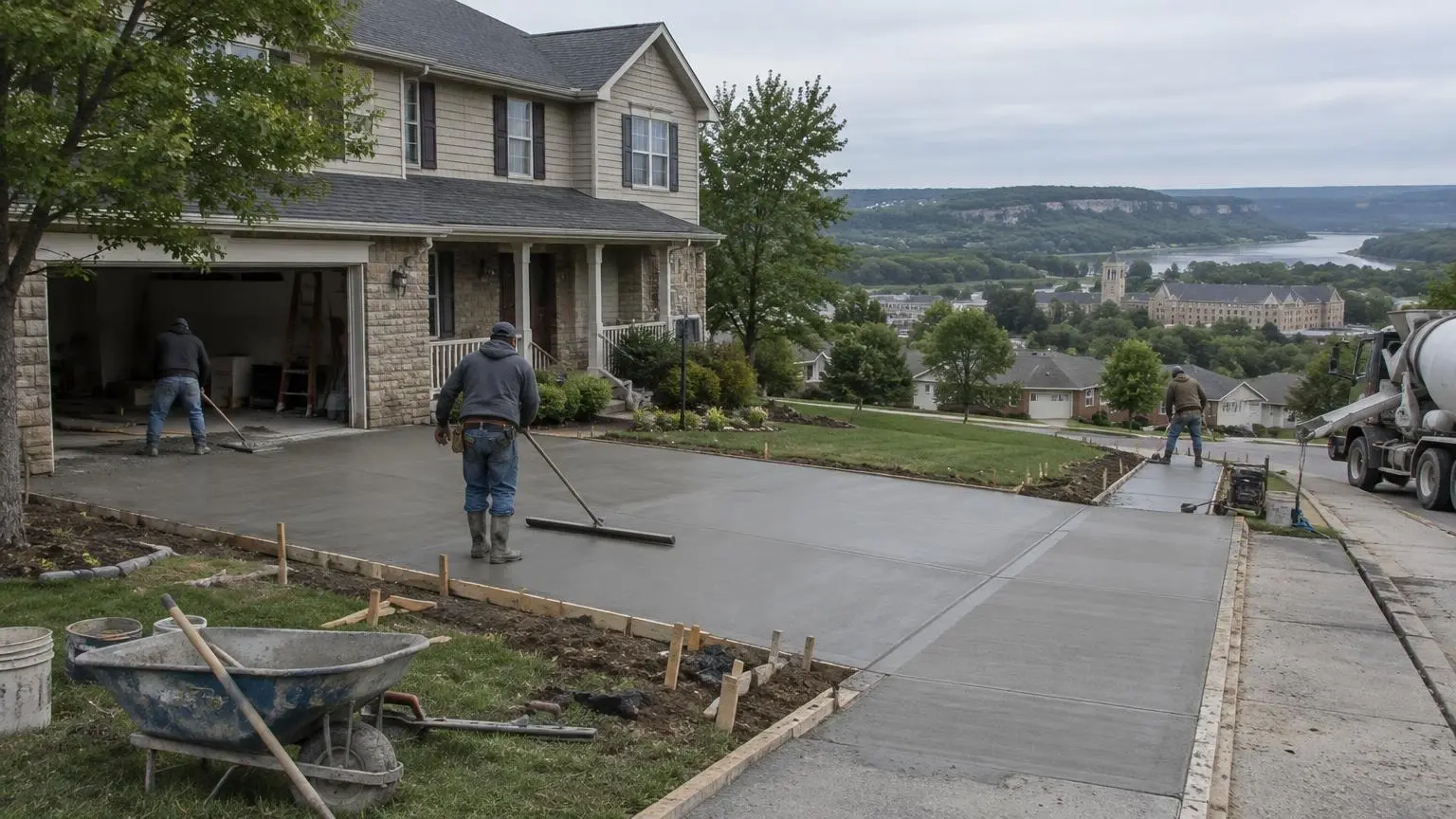
Where the Big Blue meets the Kansas River
Concrete Contractors in Manhattan, KS
Driveways, patios, steps and slabs for a river city with about six months of possible frost each year.
- We measure on site before naming a price, and the quote arrives in writing, line by line
- Every outdoor pour: compacted crushed rock underneath, air-entrained concrete, joints laid out ahead of time
- Permit and right-of-way questions checked with the city or county before a date is booked
Concrete Work Planned Around Manhattan's Ground and Weather
Manhattan is the center of our service area, and for concrete contractors two questions decide most jobs here: what the ground under a slab is doing, and what the weather will do to the surface once it is poured. The city sits where the Big Blue River joins the Kansas River, with a flat floodplain downtown and the rolling Flint Hills rising around it. Those two settings ask for different preparation, so we start every Manhattan estimate by looking at the site, not by quoting a standard slab.
A river town that keeps growing
Manhattan was founded in 1855 and incorporated in 1857. Between 2010 and 2020 the population went from 52,281 to 54,100, and the count of housing units climbed from 21,619 to 24,342. That means close to 2,700 new homes and apartments in ten years, on top of a large stock of older houses near downtown and the Kansas State University campus. The Yuma Street Historic District is one example of an older part of town that is listed on the National Register of Historic Places.
That leaves two very different kinds of jobs. Newer homes on the edges of town often need a first patio, a wider driveway or a shed slab that the builder never added. Older homes near campus and downtown more often need tired walks and steps torn out and replaced, or a driveway that has settled and cracked over decades of use.
Frost from October to April
Wikipedia's climate data for Manhattan puts the typical freeze season from October 16 to April 20. January's mean daily temperature is 29.1 degrees, July's is 80.0, and the city averages 58.9 days a year at 90 degrees or hotter. The record low is minus 35, set in 1899. Snowfall averages 17.6 inches a year, and total precipitation is 35.77 inches, most of it falling from May through August.
That range is hard on exterior concrete. Water gets into the surface, freezes, expands and pops off small flakes, a problem called scaling. Deicing salt makes it worse. For Manhattan flatwork we use air-entrained concrete, which holds tiny air bubbles that give freezing water room to expand. We slope every surface so it drains, cut control joints at the right spacing so cracks form where we want them, and cure the slab properly instead of letting it dry out in the summer sun. We also tell you when to seal it and to keep rock salt off new concrete for the first winter.
Floodplain lots and hillside lots
Downtown Manhattan was built on the floodplain, and the city's worst floods came in 1903, 1908, 1951 and 1993. In 2019, flood records that had stood since 1993 were broken again. Tuttle Creek Lake, about five miles north, was built on the Big Blue River for flood control and now holds back much of that water, but low lots near the rivers can still have soft, damp subgrade after wet spells. On those sites we pay close attention to the base: removing organic soil, bringing in and compacting granular fill, and making sure water runs away from the house rather than pooling against a garage slab.
Up in the hills, the issues change. The Flint Hills sit on a flinty limestone bedrock, often close to the surface, with clay soil and chert gravel on top. Clay swells when wet and shrinks when dry, which can lift or drop a slab. Shallow rock can also make excavation slower for footings at steps and retaining edges. We plan for both before we quote.
What we build in Manhattan
- Concrete driveways: full replacements, widened parking pads and new approaches, reinforced for daily traffic
- Concrete patios: plain broom-finish or colored slabs off the back door, sized for a grill and table
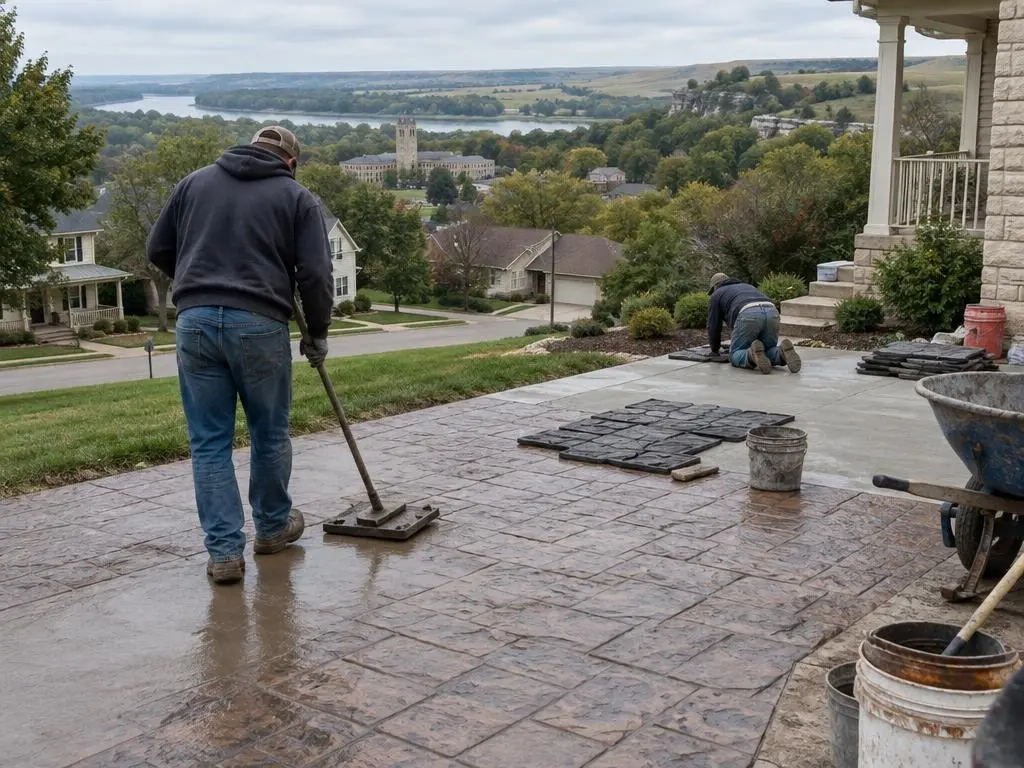
- Stamped concrete: stone and slate patterns for patios and walkways that need to look finished
- Sidewalks and steps: front walks, stoops and stair rebuilds, including older homes near campus
- Garage and shed slabs: thickened-edge slabs for detached garages, workshops and storage sheds
- Concrete repair and replacement: sunken sections, trip hazards and scaled surfaces
If a section of walk or driveway is near the street, we check with the City of Manhattan on whether a permit or right-of-way approval is needed before any work starts. Call (785) 509-7585 and we will walk the site with you, explain what we see, and give you a written estimate.
Manhattan Facts That Shape a Concrete Job
- Freeze season. Freezing temperatures typically run from October 16 to April 20, so exterior slabs need air entrainment and good drainage.
- Housing growth. Housing units rose from 21,619 in 2010 to 24,342 in 2020, a mix of new builds and older homes near campus.
- River floodplain. Downtown sits on the floodplain at the Kansas and Big Blue rivers, which flooded badly in 1951 and 1993.
- Flint Hills ground. The surrounding hills sit on flinty limestone bedrock with clay soil and chert gravel close to the surface.
Our Services in Manhattan, KS
Manhattan Questions
When should I plan a concrete pour in Manhattan?
Late spring through early fall works well, since frost is typical from mid-October to about April 20. We can pour in cooler weather with blankets and adjusted mixes, but we avoid placing concrete on frozen ground.
Will a new driveway in Manhattan crack?
All concrete shrinks as it cures, so some hairline cracking is normal. Control joints, a well-compacted base and proper curing keep those cracks in the joints and keep them small.
Do I need a permit for concrete work in Manhattan?
It depends on the project and where it sits. Work near the street or in the public right-of-way may need city approval, so we check with the City of Manhattan before we schedule your pour.
Free Estimates in Manhattan, KS
Free on-site estimates anywhere in Manhattan.
Concrete Contractors Near Manhattan
- Concrete Contractors in Junction City, KS
- Concrete Contractors in Fort Riley, KS
- Concrete Contractors in Wamego, KS
- Concrete Contractors in Ogden, KS
- Concrete Contractors in Grandview Plaza, KS
- Concrete Contractors in Milford, KS
- Concrete Contractors in St. George, KS
- Concrete Contractors in Riley, KS
- Concrete Contractors in Leonardville, KS
- Concrete Contractors in Westmoreland, KS
- Concrete Contractors in St. Marys, KS
- Concrete Contractors in Wakefield, KS
- Concrete Contractors in Alma, KS
- Concrete Contractors in Randolph, KS
- Concrete Contractors in Olsburg, KS
- Concrete Contractors in Chapman, KS
- Concrete Contractors in Louisville, KS
- Concrete Contractors in Keats, KS
- Concrete Contractors in Belvue, KS